
A healthy database leads to happy users and less support
Proactive DMS Pro Health Checks: Empowering Data Quality for Perfect Profit Insights
Introduction #
In the dynamic world of customer service, every so-called ‘hiccup’ or potential ‘red flag’ within our customer databases isn’t a cause for alarm, but rather a fertile ground for opportunity. This module will equip you with the information to look out for, to proactively perform ‘health checks’ on your Customers databases. By learning to identify potential areas of concern, we can transform them into actionable insights, allowing us to engage with our dealership and workshop owners and users, to not only address existing issues but also to forge stronger customer connections and drive enhanced service.
Understanding the DMS Pro Health Check #
The DMS Pro Health Check is a powerful tool that enables us to verify the quality and integrity of the data being input into our Customers’ VMG DMS. Think of it as a regular check-up for their data, you’re the doctor and they are the patient, ensuring everything is accurate and functioning optimally.
The Primary Focus: Perfect Profit Per Car #
The central goal of the DMS Pro Health Check is to ensure that the data recorded within the system allows us to accurately reflect the Perfect Profit Per Car in our reports and dashboards. This accurate data is paramount, as owners, shareholders, and other key stakeholders rely on it to make informed and critical business decisions.
The Bigger Picture: Enabling Future Growth #
It’s important to note that for customers considering an upgrade to DMS Accounting, successfully passing a DMS health check is a prerequisite. This highlights the fundamental importance of data quality for future system integrations and informed financial management.
Our Ultimate Goal: Empowerment Through Knowledge #
While we conduct these initial health checks, our ultimate aim is to empower our dealership and workshop partners to perform these checks themselves. By equipping them with the knowledge and skills to proactively monitor their data quality, we foster greater self-sufficiency and a deeper understanding of their DMS. Once they’ve done it a few times, the total time spent on this can be less than 10 minutes each time, providing significant long-term value.
Our Guiding Principle: The Student Mindset #
One of the most crucial aspects to remember when conducting and discussing health check findings is that VMG is NOT the admin police! There are NO RULES WE SET! The only rules that exist are determined by the desired outcomes that have been set by our customers. Just because we identify something as a potential concern, or opportunity for improvement, based on OUR understanding, doesn’t automatically mean the owner or the user perceives it the same way. You cannot seek to be understood, until you understand what is important and not important for the owner and users. SEEK FIRST TO UNDERSTAND, THEN TO BE UNDERSTOOD!
Therefore, when meeting with users and owners about health check findings, ALWAYS approach it with a student’s mindset. Our primary role is to be there to learn, not to dictate. We need to actively listen and understand if there’s a specific reason why the data is the way it is.
Only when we discover that the current data input practices are not aligning with the owner’s desired outcomes can we gently transition into a teacher role, offering guidance and solutions.
Why Perform Admin Health Checks? #
Performing regular admin health checks on our customer databases using the DMS Pro tool offers significant benefits for our dealership Customers and ultimately strengthens our relationship with them. These checks are designed to:
- Provide Peace of Mind for The Owner and Users: Ensure that essential administrative tasks are completed accurately
- Build Deeper Relationships with Owners and Users: Helps us with opportunities to build and outstandingly positive reputation
- Gives Reasons to have purpose during Site Visits: Adds value over and above just showing up for no real reason other than to just tick of site visit boxes.
- Helps People Feel Better: People want to succeed. Knowing that all the “I’s” are dotted and your “T’s” are crossed, helps you and the admin team feel great.
- It gives the admin team very clear direction, which is always a great thing.
- It helps you identify problems before they become “real” problems”.
- Get Max Value: The knowledge gained from the DMS Pro health check will help your Customers admin team to extract the most admin value from their VMG DMS.
- Lower Support Loads: A quality database requires well trained users who’s expectations have been expertly managed. This generally causes less reliance on VMG Support resources.
Why do we do Health Checks? (Provers) – by Xandre Cronje #
P – Peace of Mind
We do health checks to give the owner confidence that what they see in the system is accurate and reliable, and truly reflects what is happening in their business. It provides peace of mind that daily processes are being followed, data is captured correctly, profit and financials can be trusted.
R – Relationship
We do health checks to maintain consistent, meaningful engagement and build trust beyond standard support interactions. It demonstrates a genuine interest in the owner’s business and reinforces our role as a committed partner in their ongoing success.
O – Objective for Site Visit
We do health checks to ensure every site visit is structured and purposeful, driving meaningful business interactions. This demonstrates clear value, justifies the system and monthly investment, and reinforces our commitment to the client’s success, because without an objective you are merely moving, and without a plan you are lost. This is grounded in our VMG core values. We value judgment, meticulous attention to detail, and the consistent building of a positive, long term reputation.
V – Value Extraction
We do health checks to ensure the client is fully utilising the system and receiving the value they are paying for. It helps identify unused functionality, understand why it is not being used, and address any gaps through training, process improvement, or product and system improvements.
E – Empowerment
We do health checks to enable users to work confidently and correctly without ongoing reliance on assistance. We equip them with the knowledge and ability to operate the system independently and effectively. It also empowers the owner to improve processes, workflows, and daily operations for the betterment of the business and staff.
R – Risk Reduction
We do health checks to identify and correct red flags early before they impact financial accuracy, decision-making, system data, or user performance, ensuring the system remains reliable and trustworthy.
S – Support Reduction
We do health checks to reduce avoidable support queries by ensuring proper system usage and process adherence.
The 5 Key Reports for Initial Health Checks #
The reports below form the foundation of a perfect profit per car health check. Some of your customers may want to focus on other areas of their business. In such cases, you can expand the health check criteria for your customer. Just be sure to let everyone by adding a special comment to that customer profile in Automan.
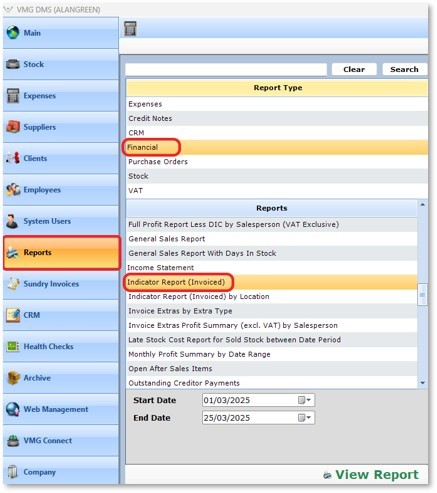
Indicator Report (Sold Stock) #
- Checks if dealer stock (DS) costs have been loaded
- As per the 2nd hand good act of SA, you may not sell something that doesn’t belong to you.
- Some dealers load their DS as Registration costs and not DS costs. This is ok in our opinion.
- Roadworthy (RW) costs have been loaded
- Besides just being the right thing to do, as per the CPA, we may not knowingly sell a defective good.
- If simple “mandatory” costs have not been loaded to their vehicles, what else hasn’t been loaded?
- Gaps on this report indicate that other admin gaps may exist.
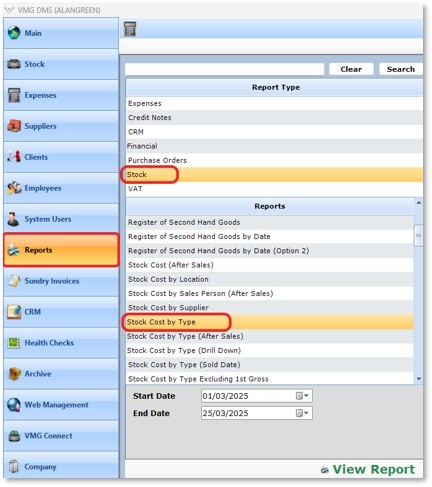
Stock Cost by Type #
- Checks whether VAT is accurately recorded on every transaction.
- This report can also be viewed by supplier (I have used this option)
Estimated Profit (EP) Report (VAT Incl or Excl) #
- All owners, generally know precisely how much each vehicle owes them.
- By looking at the EP, you will quickly determine if the admin of each car is up to date before they are sold

Full Profit (FP) Report (by Finance House) #
- All owners know precisely how much each vehicle owes them.
- By looking at the FP by Finance House, you will quickly determine if the admin of each car is up to date after they are sold.
- It checks how many bank deals occurred
- This count is then used, when reviewing the 2nd Gross Income report, to check that DIC and other commissions have been loaded correctly.

Second Gross Income Report #
- It shows us that all DIC’s and related VAPS commissions have been accurately captured.
- If you see in the FP report above, that you had 7 bank deals, then we want to see the DIC’s loaded on this report.
- If you used external F&I services, then we want to see the commissions reflected on this report.
- If invoice extras on the invoice have been marked as 2nd gross, it helps you identify that the associated costs have been accurately processed.

Facilitating the Discussion (Emphasizing the “Student Mindset”) #
This section focuses on how you should approach the conversation with the dealership, with a strong emphasis on the newly defined principle:
- Embrace the Student Mindset: Begin the discussion with genuine curiosity. Your initial goal is to understand why the data appears as it does. Ask open-ended questions to uncover the dealership’s processes and rationale.
- Emphasize Collaboration: Frame the discussion as a collaborative effort to improve their administrative processes and ultimately contribute to more accurate profit reporting, which benefits them directly.
- Present Findings Objectively: Focus on the data points identified in the reports, avoiding personal opinions or judgments. Use neutral language.
- Ask Open-Ended Questions: Encourage the dealership contact to explain their processes and reasoning behind the data entries. Examples:
- “We noticed [specific data point]. Could you tell us a bit about how this information is typically entered?”
- “Is there a particular workflow that explains why we’re seeing [specific trend]?”
- “From your perspective, does this data accurately reflect [relevant business process]?”
- Listen Actively: Pay close attention to their explanations and try to understand their perspective, even if it differs from your initial assumptions.
- Respect Their Decisions: Ultimately, the dealership owns their data and their processes. If they have a valid reason for the data being the way it is, even if it doesn’t align with what you might consider “best practice,” acknowledge and respect their decision.
- Transition to Teacher (If Appropriate):Only after fully understanding their current processes and identifying a misalignment with their desired outcomes can you gently offer suggestions or alternative approaches. Frame these suggestions as potential ways to achieve their goals more effectively. Example: “Based on what you’ve shared about wanting more accurate profit per car reporting, have you considered [alternative method]?”
- Offer Solutions and Support: Be prepared to share your expertise and offer practical solutions or further investigation if the dealership is open to making changes.
- Document Outcomes: Record the key points of the discussion, including the dealership’s explanations and any agreed-upon actions and add these to, automan comments, your progress report, or status updates This helps in future follow-ups and ensures a clear understanding of their specific needs and priorities.
Conclusion #
“By diligently performing these proactive DMS Pro health checks with a curious and collaborative ‘student mindset,’ we can build stronger relationships with our dealership Customers and Users. Our focus on understanding their unique processes and ultimately empowering them to achieve accurate ‘Perfect Profit Per Car’ reporting will drive mutual success and long-term value.”