Skip to content

VALUES VISION MISSION STRATEGY

4
  • Our Core Values
  • Our Core Strategy
  • Our Mission
  • Our Vission

ONBOARDING NEW CUSTOMERS

19
  • Project Management 101
  • OS Onboarding Guide – New Dealership
  • OS Onboarding Guide – Migrating Existing Dealership
  • The Onboarding Process
  • Expectation Management
  • The Demo
  • Demo Notes – by Kendall Adams
  • Quality User Experience
  • The Quote
  • Quote Notes – by Kendall Adams
  • Quote Mistakes
  • The Take-On
  • The Welcome Email
  • Install and Setup WMS
  • Progress Reports
  • Status Update Emails
  • User Alert Emails
  • DMS Onboarding Checklist
  • WMS Onboarding Checklist

VMG ACCOUNTING

16
  • DMS Accounting Take On Rules
  • WMS Accounting Take On Rules
  • DMS with WMS Accounting Take On Rules
  • Opening Balances Process
  • Cost of Sale @ Point of Sale Process
  • VMG MULTIBRANCH
  • Accounting Fundamentals
  • What type of bookkeeping platform is VMG?
  • Suggested Paperwork Process Flow
  • VMG Bookkeeping Process Flow
  • The Onboarding Process
  • Quality User Experience
  • Accounting Assessment
  • Inventory Costing Methods
  • User Alert Emails
  • VMG Bookkeeping Services Agreement

VMG WORKSHOP PRO

14
  • PREPARING PARTS FOR WEBSITE DISPLAY
  • Jobcard Workflow
  • Inventory Costing Methods
  • WMS Onboarding Checklist
  • User Alert Emails
  • DMS & WMS Mobile Assessment
  • WMS Pro Assessment
  • The Onboarding Process
  • Install and Setup WMS
  • WMS Product Knowledge Builder
  • Inventory Costing Methods
  • Mobile App Stock Take
  • JobCard Timer
  • In Progress: DMS & WMS Integration

VMG DMS PRO

10
  • DMS 101 Practical Assessment
  • Transunion Pricing 2026
  • Managing Over Allowance
  • DMS Pro Health Check
  • Floor Plan Management
  • The Onboarding Process
  • DMS Onboarding Checklist
  • User Alert Emails
  • DMS & WMS Mobile Assessment
  • DMS Pro Assessment

WORKING WITH OTHERS

8
  • Project Management 101
  • People Are Who You Make Them
  • Relationships & Influence
  • Problem Solving Step by Step
  • Quality User Experience
  • Mastering Effective Communication
  • Professional Selling
  • Expectation Management

ASSESSMENT TOPICS AND QUESTIONS

20
  • WMS 101 Practical Assessment
  • DMS 101 Practical Assessment
  • VMG Accounting 101 Test
  • High Level Knowledge Assessment
  • Add-Ons Department Knowledge Assessment
  • Support Department Knowledge Assessment
  • Technical Knowledge Assessment
  • Domains And Emails Knowledge Assessment
  • Society Knowledge Assessment
  • Industry Knowledge Assessment
  • Training Knowledge Assessment
  • Sales Knowledge Assessment
  • WMS Pro Assessment
  • DMS Pro Assessment
  • Accounting Assessment
  • Onboarding New Customers Asessment
  • DMS & WMS Mobile Assessment
  • CRM Assessment
  • Management Knowledge Assessment
  • Business Knowledge Assessment

VMG HIGH-LEVEL

6
  • Food for Thought: LLM Threat to VMG SaaS
  • Project Management 101
  • What is VMG Software?
  • VMG Departments
  • Data Security and Confidentiality Policy
  • The VMG Service Ethos

VMG ADD ONS DEPT

2
  • VMG Website Templates 2025
  • Quick Guide: AutoTrader Feed

VMG FRONTLINE

13
  • 2026 Pricing (VAT Incl)
  • Install and Setup WMS
  • Quality Site Visits
  • Welcome to the VMG Frontline Team
  • What is VMG Software?
  • The Frontline Job Description
  • The Frontline Duties and Responsabilities
  • Our Culture
  • Our Commitment to the Motor Industry and VMG
  • VMG Departments
  • Our Competitors
  • Our Market
  • The VMG Service Ethos

VMG SUPPORT DEPARTMENT

3
  • DMS Installation Protocol
  • Install and Setup WMS
  • The VMG Service Ethos

MANAGEMENT & LEADERSHIP

7
  • Project Management 101
  • How to make new staff members feel part of VMG
  • The Leadership Trifecta
  • Leadership: Accountability without Micromanagement
  • Leadership: Accountability – How to Build It
  • Management Basics
  • Leadership Styles

BUSINESS KNOWLEDGE

5
  • Project Management 101
  • Business Agreements
  • Governments Role In Business?
  • How Business are Setup in South Africa?
  • Why Do Businesses Exist?

THE CAR PLACE

2
  • Transunion Pricing 2026
  • Reseller Products Sign Up process

VMG ONLINE

3
  • OS Onboarding Guide – Migrating Existing Dealership
  • Creating 3rd Party Vendor API Keys
  • OS Onboarding Guide – New Dealership

PROFESSIONAL USER TRAINING

3
  • The Essential Training Delivery Module
  • What is Leaner Centricity
  • Training Phases – WMS

VMG CRM

2
  • Questions the Sales Manager Needs to Answer
  • CRM Assessment

VMG LAB DEPARTMENT

5
  • Protected: Report Requirements
  • Protected: Ticket Point System
  • Protected: Ticket Life Cycle
  • Protected: VMGOS Deployment – Backend
  • Protected: VMGOS Deployment – Frontend
View Categories

Inventory Costing Methods

4 min read

0:00 / 4:23
  • View as Markdown Open this page as plain Markdown (opens in a new tab)
  • Open in ChatGPT Ask questions about this page (opens in a new tab)
  • Open in Claude Ask questions about this page (opens in a new tab)
  • Open in Google AI Studio Ask questions about this page (Google account required) (opens in a new tab)
FIFO, LIFO, and Average Costing #

Understanding Inventory Costing Methods: FIFO, LIFO, and Average Costing (VMG WMS Uses Average Costing) #

It’s important to understand different inventory costing methods because you might discuss these concepts with senior personnel and accountants at our workshop customers. While our VMG WMS system uses the average costing method, knowing about FIFO and LIFO will provide a broader understanding of inventory valuation.

Inventory Valuation: A Quick Overview

Inventory valuation is how we determine the cost of the parts we have in stock. This is crucial for calculating the Cost of Goods Sold (COGS) – the direct costs associated with the parts used in workshop repairs – and ultimately, our profitability. It also affects how our inventory is valued on our financial statements.

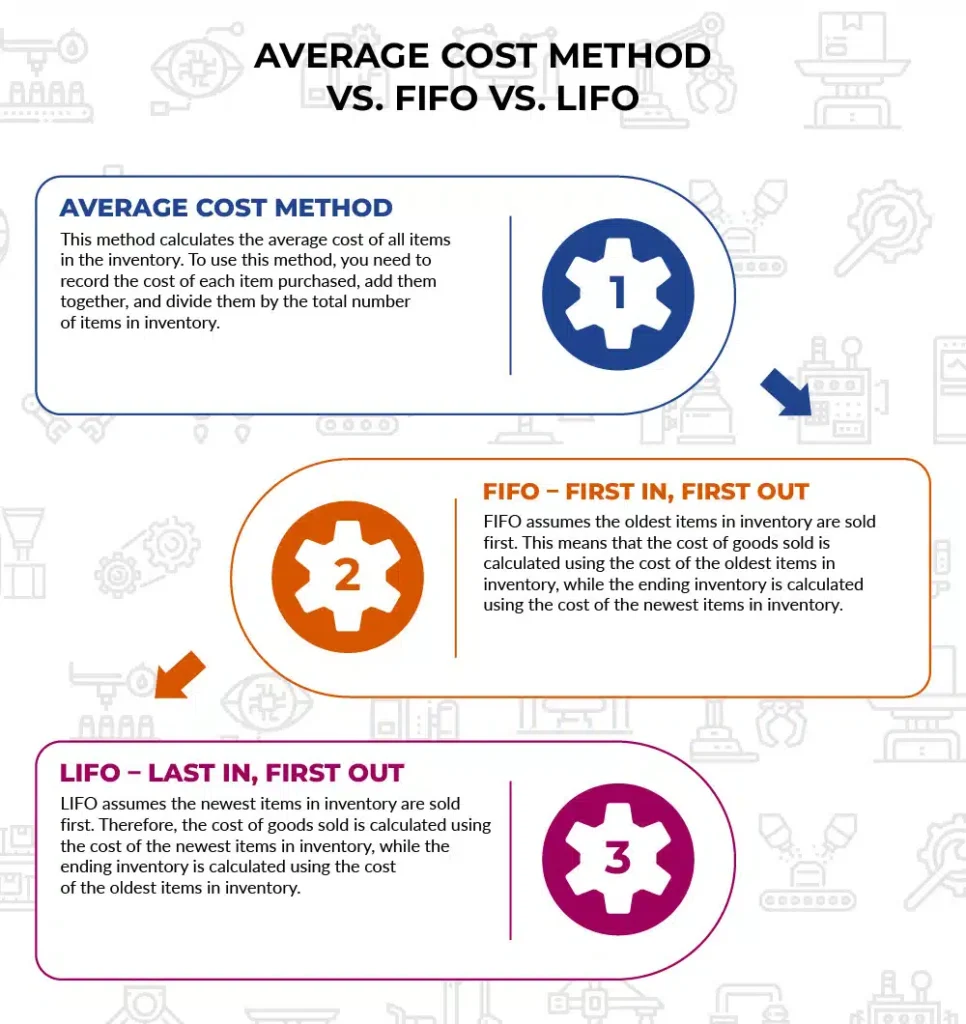
There are three main methods:

  #
What Is the Average Cost Method? (This is what VMG WMS uses) #

The average cost method calculates a new average cost each time new stock of a particular part is received.

How it Works in VMG WMS:

  1. When you receive new stock of a part, the total cost of all units of that part currently in stock (including the new ones) is added together.
  2. This total cost is then divided by the total number of units now in stock.
  3. The result is the new average cost per unit.
  4. When a part is used on a job card, the average cost at that time is used to determine the cost of that part.

Example:

Let’s say we have 10 of a specific filter in stock, each costing $10 (total value $100). We then receive another 20 of the same filter, but this time they cost $12 each (total value $240).

The new average cost per filter would be:

Total Cost = R100 (old stock) + R 240 (new stock) = R 340
Total Units = 10 (old stock) + 20 (new stock) = 30
Average Cost = R 340 / 30 = R 11.33 per filter (approximately)

Now, if a technician uses one of these filters on a job card, the cost recorded for that filter will be R 11.33.

When is the Average Cost Method Most Appropriate?

  • When dealing with a large number of similar parts where tracking the individual cost of each item isn’t practical.
  • When the price of raw materials (in our case, the parts we purchase) fluctuates. The average cost helps to smooth out these fluctuations for costing purposes.
  • It’s generally easier to track compared to FIFO or LIFO as you don’t need to remember which specific batch of stock was used.

  #

What Is the FIFO (First In, First Out) Method? #

FIFO assumes that the first parts we received into our inventory are the first ones we use or sell. Think of it like a queue – the parts that have been in stock the longest are used first.

How it Would Work (If VMG WMS used FIFO):

If a job card required a part, the cost of that part would be based on the cost of the oldest units of that part in our inventory. Only when the entire initial stock is used would we start costing based on the next batch of stock received.

When is the FIFO Method Most Appropriate?

  • When the physical flow of inventory naturally follows a first-in, first-out pattern (e.g., perishable goods).
  • In times of rising prices, FIFO can make a business appear more profitable because the older, cheaper inventory is being used for the cost of goods sold, leaving the newer, more expensive inventory in stock.

  #

What Is the LIFO (Last In, First Out) Method? #

LIFO assumes that the last parts we received into our inventory are the first ones we use or sell. It’s the opposite of FIFO.

How it Would Work (If VMG WMS used LIFO):

If a job card required a part, the cost of that part would be based on the cost of the most recently received units of that part in our inventory.

When is the LIFO Method Most Appropriate?

  • LIFO can sometimes be used to reduce taxable income during periods of rising prices because the higher cost of the newest inventory is assigned to the cost of goods sold, resulting in lower profits on paper.

Important Note: LIFO is not permitted under International Financial Reporting Standards (IFRS), which are used in many parts of the world. It is primarily used in the United States under US GAAP.

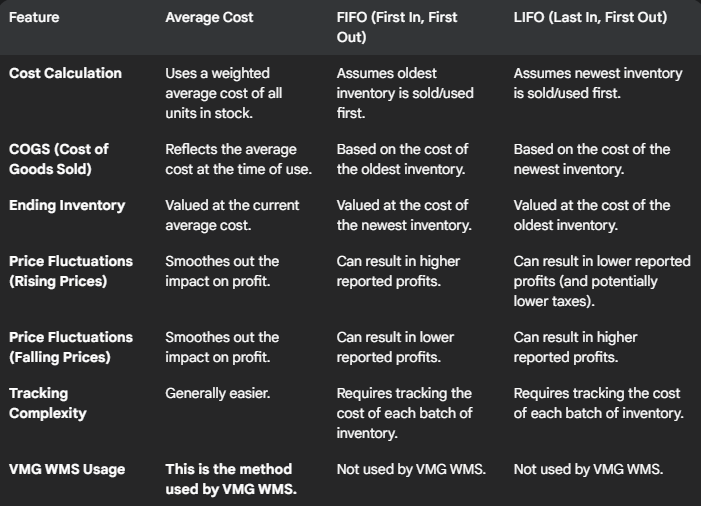
Key Differenes Summarised
In Conclusion:

While FIFO and LIFO are other methods for valuing inventory, our VMG WMS system uses the average cost method. This means that the cost of parts used in workshop repairs is based on the constantly updated average cost of those parts in our inventory. Understanding all three methods will help you have more informed conversations with our workshop customers about their inventory management and accounting practices.

Updated on July 14, 2025
Table of Contents
  • FIFO, LIFO, and Average Costing
  • Understanding Inventory Costing Methods: FIFO, LIFO, and Average Costing (VMG WMS Uses Average Costing)
    •  
    • What Is the Average Cost Method? (This is what VMG WMS uses)
    •  
    • What Is the FIFO (First In, First Out) Method?
    •  
    • What Is the LIFO (Last In, First Out) Method?