
Effective communication is the cornerstone of successful interactions, whether in personal relationships or professional settings. It’s the process of exchanging information, ideas, and feelings so that the message is accurately received, understood, and generates the desired response.
What Effective Communication Is #
Effective communication isn’t just about speaking or writing clearly; it’s a two-way street that involves both a sender and a receiver. The sender must transmit the message clearly and concisely, using language and non-verbal cues appropriate for the audience. Crucially, the receiver must actively listen or read and correctly interpret the sender’s intended meaning. It transcends merely conveying information; it involves building mutual understanding and trust.
- Mutual Understanding is Achieved: The receiver’s interpretation of the message aligns precisely with the sender’s intent. This is often confirmed through feedback.
- The Desired Outcome Occurs: The communication achieves its practical purpose, whether it’s the completion of a task, a change in behavior, or a resolution to a conflict.
- Minimal Misunderstanding/Conflict: There is little to no confusion, leading to fewer errors or follow-up questions for clarification.
- Active Engagement is Evident: The receiver demonstrates they are listening or reading through appropriate verbal (e.g., summarizing, asking relevant questions) and non-verbal (e.g., eye contact, nodding) cues.
The Communication Loop #
A communication loop is a two-way communication process where a sender transmits a message and a receiver provides feedback to confirm understanding. This feedback, which can be verbal or non-verbal, allows the original sender to confirm the message was received correctly. When the receiver repeats the message and the sender confirms, the loop is “closed,” preventing misunderstandings.
The communication loop process
- Sender transmits: The sender creates and sends a message through a chosen channel.
- Receiver receives and decodes: The receiver gets the message and interprets it. Misinterpretations can occur due to noise, different frames of reference, or a poor choice of channel.
- Receiver provides feedback: The receiver responds to the sender. This is the feedback that creates the loop and ensures the message was understood.
- Sender receives feedback: The original sender receives the feedback, which completes the loop.
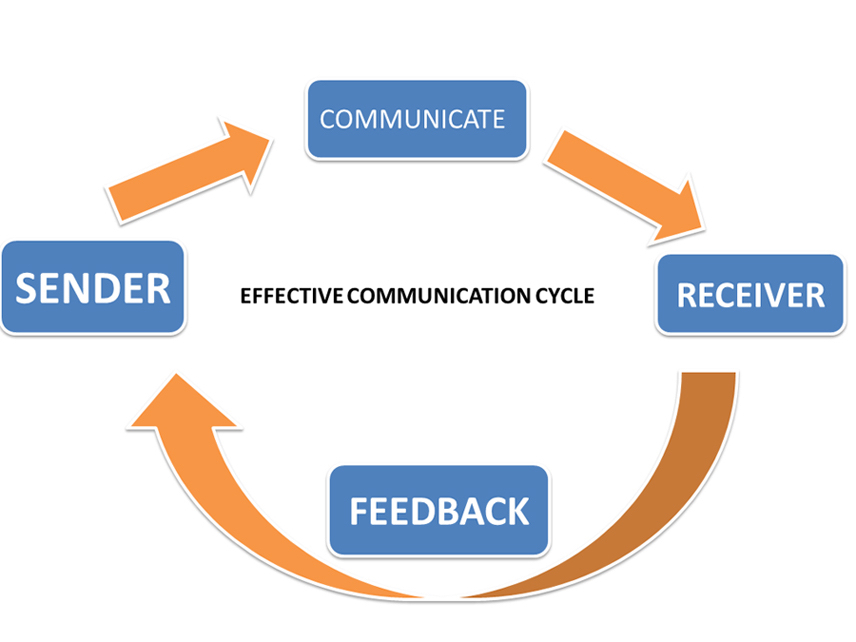
Closed-loop communication
This is a specific technique to ensure a message is not only heard but also correctly understood and acted upon.
- How it works: The receiver repeats the message back to the sender, and the sender confirms that the repetition is correct.
- Example: A doctor says, “Give the patient 5mg of morphine.” The nurse responds, “I will administer 5mg of morphine,” and the doctor replies, “Correct,” closing the loop.
- Benefits: It is a simple but effective way to avoid errors, save time, and build mutual understanding, especially in critical situations like healthcare.
Related concepts
- Open loops: A technique to keep an audience engaged by creating curiosity and withholding information until a later point. It’s like a “cliffhanger” in a conversation.
- Stuck loops: An unhealthy, repetitive communication pattern where individuals get caught in a cycle of the same arguments or issues without resolution.
- Feedback loops: A broader concept that emphasizes the ongoing, cyclical nature of communication, which is essential for long-term improvement and growt
Knowing When Communication Is Effective #
You know communication has taken place effectively when:
- Mutual Understanding is Achieved: The receiver’s interpretation of the message aligns precisely with the sender’s intent. This is often confirmed through feedback.
- The Desired Outcome Occurs: The communication achieves its practical purpose, whether it’s the completion of a task, a change in behavior, or a resolution to a conflict.
- Minimal Misunderstanding/Conflict: There is little to no confusion, leading to fewer errors or follow-up questions for clarification.
- Active Engagement is Evident: The receiver demonstrates they are listening or reading through appropriate verbal (e.g., summarizing, asking relevant questions) and non-verbal (e.g., eye contact, nodding) cues.
Mediums of Implementation #
Effective communication can be implemented through a variety of mediums, each with its own strengths and weaknesses:
- Verbal Communication:
- Face-to-Face: The richest form, allowing for immediate feedback and observation of non-verbal cues.
- Telephone/Video Calls: Allows for immediate dialogue but reduces or eliminates visual cues.
- Presentations/Meetings: Ideal for conveying information to large groups and facilitating group discussion.
- Written Communication:
- Emails/Memos: Efficient for formal documentation, detailed instructions, or communication across time zones.
- Reports/Articles: Best for comprehensive, lasting, and well-researched information.
- Instant Messaging/Texting: Useful for quick, informal exchanges and urgent updates.
- Non-Verbal Communication:
- Body Language: Includes posture, gestures, and facial expressions, which often convey more meaning than words alone.
- Tone of Voice (Paralanguage): The emphasis, pitch, and speed of speech, which heavily influence the perceived meaning of a message.
- Visual Aids: Charts, graphs, and images used to enhance understanding and clarity.
Why Mastery Is Important #
Mastering effective communication is crucial for virtually every facet of life:
- Career Success: It leads to better collaboration, clearer delegation, stronger leadership, and successful negotiation. Studies consistently show it is a top skill employers seek.
- Stronger Relationships: In personal life, it fosters deeper connections, resolves conflicts constructively, and builds empathy and trust.
- Increased Productivity: When instructions are clear and expectations are understood, less time is wasted on corrections and rework, driving efficiency.
- Enhanced Problem-Solving: Clear articulation of problems and active listening to potential solutions facilitate faster, more accurate decision-making.
Ultimately, effective communication is the essential tool that transforms a solitary thought into a shared reality.